I once wrote my name starting from the second box instead of the first one on my CBSE Class 10 OMR sheet. By the time I realized it, half my name was already bubbled in wrong, and there was no way to erase filled circles cleanly. That five-minute panic in the exam hall taught me to respect this sheet a lot more than I used to.
If you are looking for details on the CBSE Class X OMR sheet for board exams, you are probably preparing for your own Class 10 boards right now. I have actually held this exact sheet in my hands during a mock exam, and I want to walk you through every section so you do not repeat my mistake.
What the CBSE Class X OMR Sheet Actually Looks Like
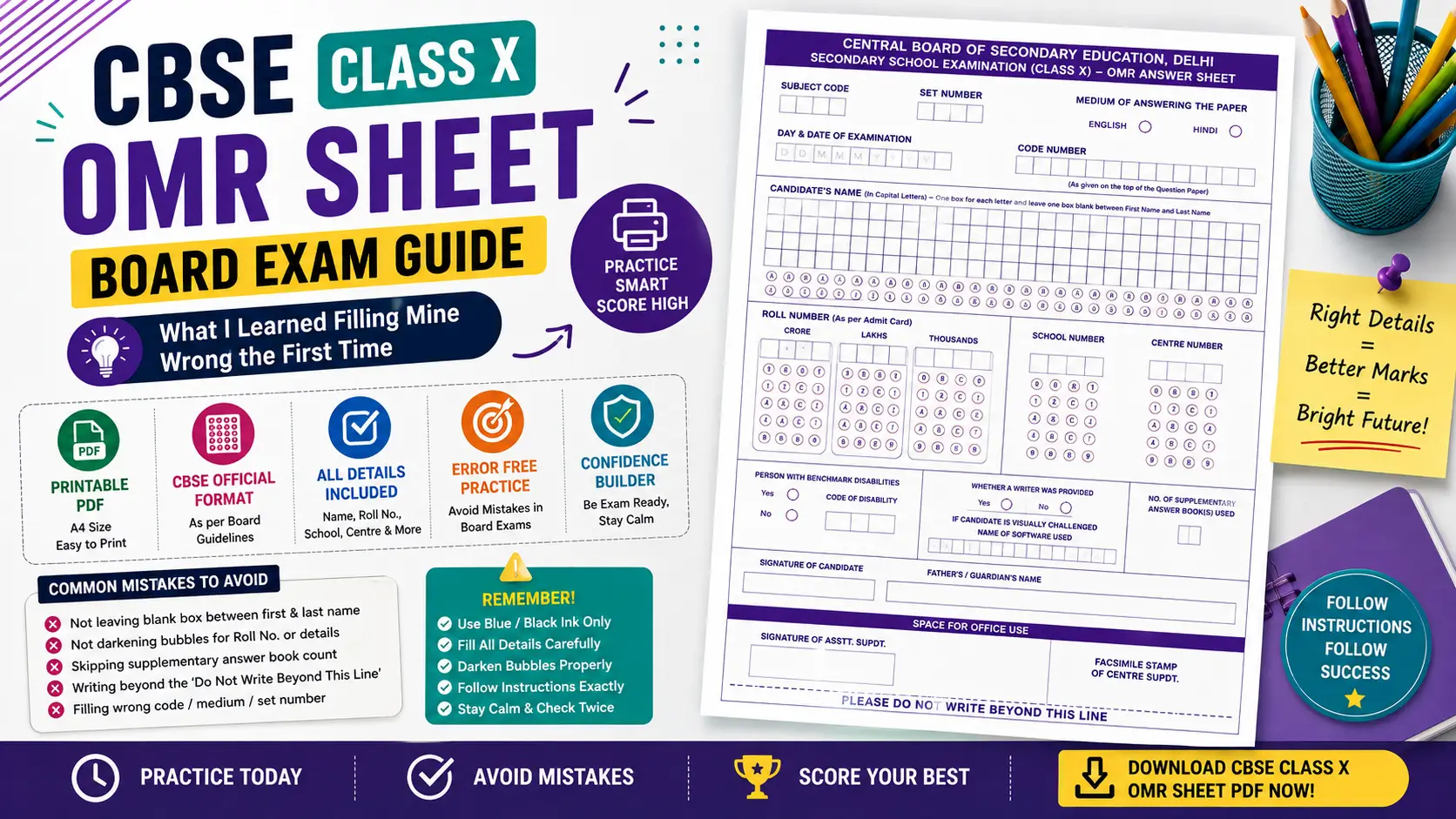
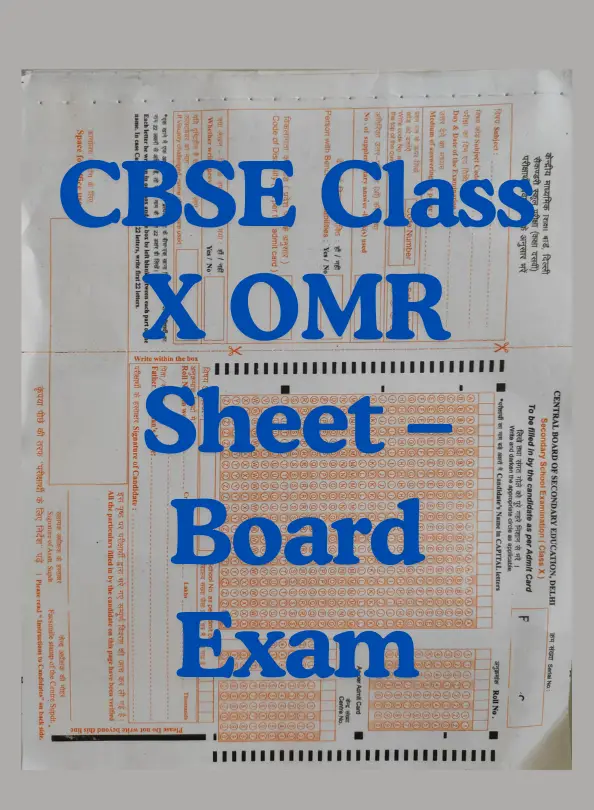
This is not your regular practice bubble sheet with just question numbers and options. The official CBSE OMR sheet, used for Secondary School Examination Class X, is a detailed form with dozens of small boxes and circles that all need to be filled correctly. It is issued by the Central Board of Secondary Education, Delhi, and it comes with clear bilingual instructions in Hindi and English.
The top section of the sheet asks for your Subject Code, Set Number, and the Day and Date of the Examination. Right next to it, there is a section for the Medium of answering the paper, along with a Code Number that you need to copy exactly as written on the top of your question paper. Getting even one digit wrong here can cause mismatched evaluation, so this section deserves your full attention, not a rushed glance.
The Name and Roll Number Grid Nobody Warns You About
This is the part that tripped me up during my first attempt. The sheet has a large grid of boxes for writing your Candidate’s Name in CAPITAL letters, with one letter per box and one blank box left between each part of the name. If your full name is longer than 22 letters, the instructions clearly say to write only the first 22 letters and skip the rest.
I did not read this rule properly the first time, and I started writing my name from the very first box without leaving any blank boxes between my first and last name. This pushed my entire name sequence forward, and by the time I reached my surname, I had run out of boxes. I had to start over on a fresh mock sheet, which is not even an option during a real board exam.
Right below the name grid, there is a separate section for your Roll Number written in words, split into Crore, Lakhs, and Thousands columns. This feels unusual if you have never seen it before, since most exams only ask for a Roll Number in digits. I remember genuinely pausing and thinking for a second the first time I saw this, because writing a roll number in word form is not something schools normally practice.
Step-by-Step: How I Fill My CBSE Class X OMR Sheet Now
After my messy first attempt, I built a fixed order for filling this sheet, and I follow the exact same order every single time now. This routine saved me from any confusion during my actual mock tests later.
- I first fill the Subject Code, Set Number, and Code Number exactly as printed on the actual question paper.
- I write the Day and Date of the Examination and select the correct Medium of answering the paper.
- I carefully write my Candidate’s Name in capital letters, leaving one blank box between my first and last name.
- I darken the matching circle below each letter box, checking twice that each circle lines up with the correct letter.
- I fill my Roll Number as per my admit card, then separately write it out in words under Crore, Lakhs, and Thousands.
- I fill the School Number and Centre Number sections, copying both exactly as shown on my admit card.
- I answer the Yes or No boxes for Person with Benchmark Disabilities and Whether a writer was provided, only if they actually apply to me.
- I sign in the Signature of Candidate box and write my Father’s or Guardian’s Name clearly in the space given.
- Right at the end, I double check that I have not written anything beyond the line marked “Please Do Not Write Beyond This Line.”
Following this exact order removed all my confusion. I stopped skipping around the sheet randomly, which is honestly where most silly mistakes happen in the first place.
Real Details From the Actual Sheet That Matter
A few smaller sections on this OMR sheet are easy to overlook, but they genuinely matter for certain students. There is a specific box asking whether the candidate is a Person with Benchmark Disabilities, along with a Code of Disability box that needs to match exactly what is written on the admit card. Right next to it, there is a Yes or No box asking whether a writer was provided, and if the candidate is visually challenged, a separate line asks for the name of the software used.
There is also a box for the Number of supplementary answer books used, which many students genuinely forget to fill even after actually using extra sheets during their exam. I have heard of students getting confused during evaluation simply because this box was left blank despite having used a supplementary booklet. Filling this correctly takes two seconds, but skipping it can create unnecessary confusion later.
At the very bottom of the sheet, there is a Signature of Candidate section along with a “Space for office use” clearly marked out separately. This part is meant only for the examination staff, and students should never write anything inside that boxed area. The sheet also carries a line for the Signature of Asstt. Supdt and a Facsimile stamp of the Centre Supdt, confirming that all your details have been properly verified by the invigilator.
Mistakes I Made and What I Learned
Beyond the name box mistake, I also once darkened a circle lightly with a regular ballpoint pen instead of a proper dark pencil during a mock attempt. My teacher immediately flagged it, since these bubble sections are meant to be filled dark and clear for accurate scanning. Half-hearted, light marks can genuinely cause reading errors even if you selected the correct option.
I also skipped darkening the circles under my Roll Number once, assuming that writing the digits clearly was enough. My teacher explained that the written digits are only for human reference, and the actual scanning machine reads only the darkened circles below them. Since then, I always check that every written detail also has its matching circle filled in properly.
Another thing I learned the hard way is respecting the “Please Do Not Write Beyond This Line” instruction printed clearly on the sheet. I once let my handwriting drift slightly past that line while writing my Father’s name in a rush. It did not cause a major issue in my case, but it is clearly something the sheet design specifically warns against, so it is best avoided entirely.
Common Mistakes to Avoid
Based on my own experience and what I have seen among classmates practicing with this exact sheet format, these mistakes come up repeatedly.
- Not leaving a blank box between the first name and last name inside the Candidate’s Name grid.
- Writing digits or letters clearly but forgetting to darken the matching circles underneath.
- Leaving the supplementary answer book count blank despite actually using extra sheets.
- Filling the Person with Benchmark Disabilities or writer-related boxes when they do not actually apply.
- Letting handwriting cross beyond the marked “Do Not Write Beyond This Line” boundary.
- Rushing through the Subject Code and Set Number section without cross-checking it against the actual question paper.
Catching even two or three of these early during your practice attempts genuinely reduces stress on your real board exam day.
Final Thoughts
The CBSE Class X OMR Sheet is far more detailed than a regular bubble answer sheet, and it deserves a proper practice run before your actual board exam. I learned this only after messing up my own name grid during a mock test and having to start completely fresh. Once you understand every section, from the Subject Code at the top to the Signature of Candidate at the bottom, filling it becomes second nature.
Take one full mock attempt with an actual CBSE-style OMR sheet before your real exam, and go through each section slowly the first time. By the time your actual board exam day arrives, filling this sheet correctly will feel automatic, leaving your full attention free for the actual questions ahead.