I still remember the exact moment my heart skipped a beat. It was my first pre-board exam in 12th grade. The invigilator handed me a crisp, unfamiliar answer sheet. It was not just a regular notebook. It was a formal 12th class OMR sheet board exam document. My hands actually shook as I looked at the grid of tiny circles. I had studied for months, but suddenly, I felt completely lost.
I stared at the top section of the paper. It asked for my Roll No., Centre Code, and Subject Code. I had never filled out anything this official before in my life. I made a tiny smudge while darkening a bubble. I panicked, thinking the scanning machine would reject my entire paper. That single moment taught me a massive lesson. Knowing the subject is only half the battle.
You must also know how to handle the answer sheet itself. A silly bubbling error can ruin months of your hard work. I spent the next few weeks mastering this specific skill. I want to share exactly what I learned with you today. Let us break down how to tackle this sheet with total confidence.
Decoding the 12th Class OMR Sheet Layout
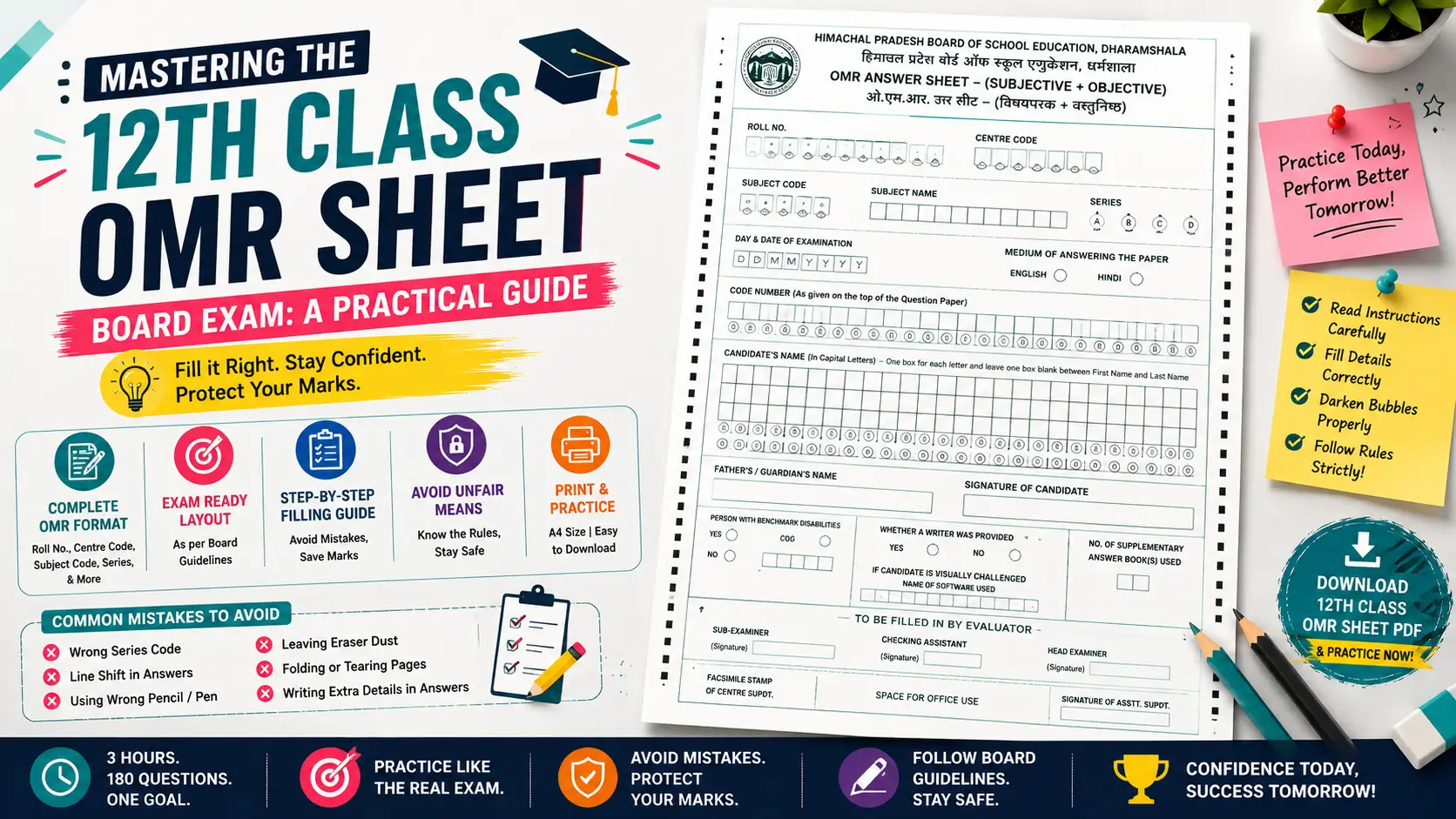
Let us look at what this sheet actually contains. I will use the Himachal Pradesh Board (HPBOSE) 10+2 format as our real-world example. This board uses a very standard and clear layout for its 12th class exams. Understanding this layout will help you no matter which state board you belong to.
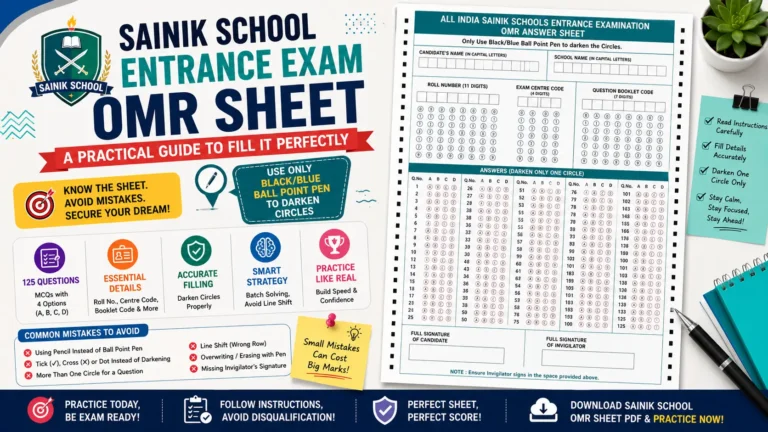
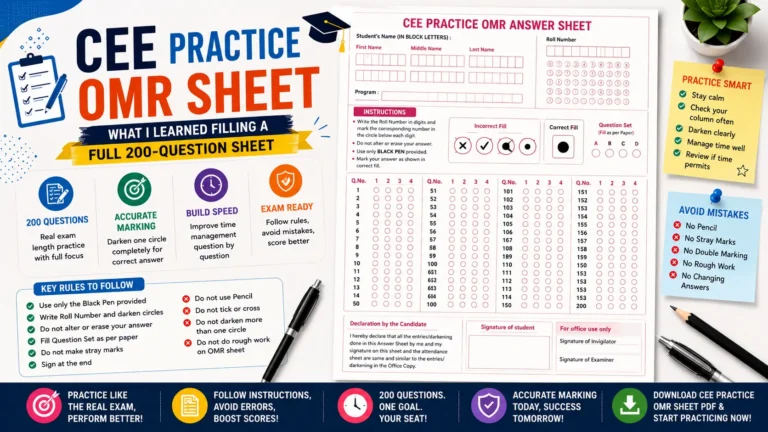
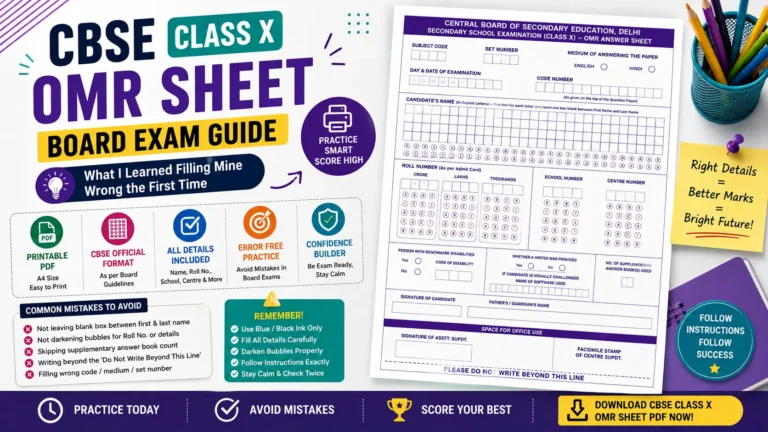
The top section is purely for your identification. You will see boxes for your Roll No. and Centre Code. You must write these numbers and darken the corresponding circles below them. Accuracy here is absolutely non-negotiable for the scanning machine.
Next, you will find the Subject Code and Subject Name. For example, Mathematics is often coded as 057. You must match this code exactly with your admit card. A wrong subject code can route your answers to the wrong evaluation team.
Then comes the most critical part: the Series code. Your question paper will have a Series printed at the top, like A, B, C, or D. You must copy this exact letter onto your OMR sheet. If your paper is Series B, but you bubble Series A, your answers will be graded against the wrong key.
My Step-by-Step Filling Strategy
I developed a strict routine for filling out these sheets. I followed this routine in every single mock test I took. You should adopt a similar routine to build strong muscle memory. Here is the exact step-by-step process I used.
Step one is to fill in the static details immediately. As soon as you get the sheet, write your Roll No. and Centre Code. Darken those bubbles carefully with a sharp HB pencil. Do this before you even read the first question.
Step two is to locate the Series code on your question paper. Write that letter clearly in the designated Series box. Then, darken the matching bubble. Double-check this against your question paper header. This takes five seconds but saves your entire exam.
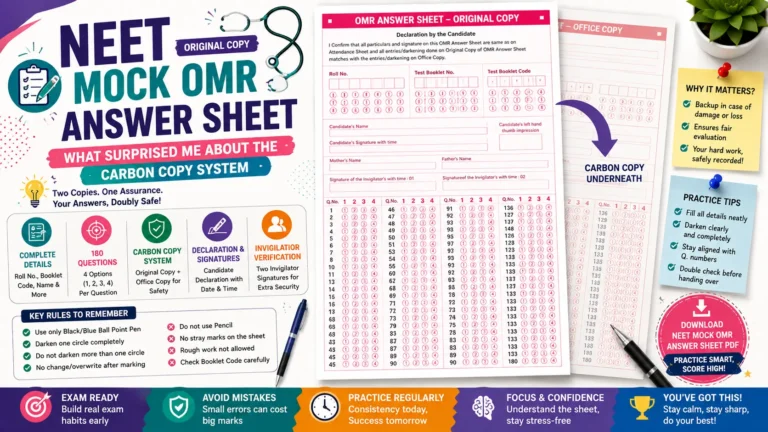
Step three involves your personal verification. Write your name and your father’s or guardian’s name in capital letters. Sign your name in the Signature of Candidate box. The official guidelines strictly emphasize that all particulars must be verified by you.
Step four is the actual answering process. I answered questions in blocks of ten. I would solve ten questions in the booklet. Then, I would transfer those ten answers to the OMR sheet. This kept me perfectly aligned and prevented massive shifting errors.
The Unfair Means Trap You Must Avoid
The back of the official sheet lists strict Instructions to Candidates. It also details what constitutes an Unfair-Means Case (U.M.C.). I see students accidentally trigger these rules every single year. You need to be fully aware of these boundaries.
First, never carry mobile phones or electronic gadgets into the hall. Even a switched-off smartwatch can get your result marked as U.M.C. The rules explicitly state that possessing unauthorized material is a severe violation. Leave all electronics outside the exam center.
Second, do not tear out any pages from the answer book. The guidelines strictly forbid tearing or folding the pages. If you make a mistake, cross it out neatly with a single line. Do not rip the page out, as this will invalidate your entire exam.
Third, never write your roll number or school name inside your written answers. The instructions clearly state that you must not do this. The evaluators only look at the designated header section for your identity. Writing it elsewhere can be flagged as a special mark.
A Look Behind the Scenes: The Evaluator Section
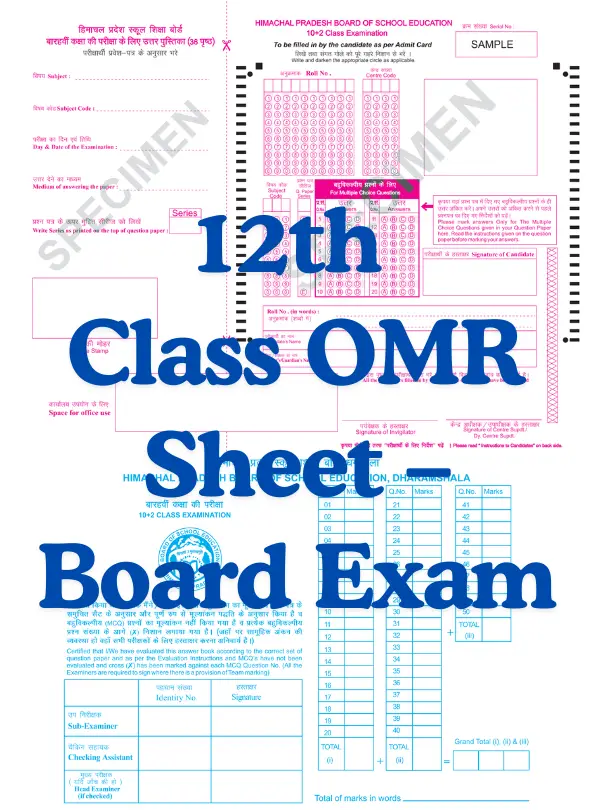
One fascinating detail I noticed on the official HPBOSE sheet is the evaluator section at the bottom. It includes spaces for the Sub-Examiner, Checking Assistant, and Head Examiner to sign. It explicitly states that MCQs are evaluated based on the correct set of question papers.
This reassured me that the machine grading is highly regulated. Knowing that multiple officials verify the process gave me peace of mind. It reminded me that the system is designed to be fair, as long as I follow the rules. The board takes the evaluation process very seriously.
Real Tools to Practice at Home
You cannot master this skill just by reading about it. You need to practice with physical sheets under timed conditions. I used a few simple tools to simulate the real exam environment at home. You can easily set this up in your own study room.
I started by downloading free 12th class OMR sheet PDFs. Websites like omrsheetpdf.com offer excellent, printable templates. I printed these on standard A4 paper using a laser printer for sharp, dark bubbles. I always set my printer to Actual Size to prevent shrinking.
I also used a simple timer app called Forest on my phone. I would set it for three hours and put the phone in another room. This forced me to focus entirely on the paper, just like in the real exam hall. It built my stamina and improved my time management drastically.
For reviewing my mistakes, I used a scanning app like CamScanner. I would scan my filled OMR sheet after each mock test. This allowed me to see exactly how my bubbles looked to a machine. If a bubble looked faint or smudged, I knew I needed to press harder next time.
Common Mistakes That Cost Valuable Marks
I have graded practice tests and seen brilliant students lose marks unnecessarily. These errors are completely avoidable with a little bit of awareness. Please read these carefully so you do not repeat them on your final board exam.
Mistake one is using the wrong writing instrument. Many boards prefer a dark HB pencil for bubbling. Some specific instructions mention blue-black or royal blue ink for written parts. Always read the front page of your specific sheet. When in doubt, a sharp HB pencil is the safest bet for the bubbles.
Mistake two is the dreaded line shift. You skip question 42 in the booklet. But you bubble the answer for 42 into the slot for 43 on the sheet. From that point on, every single answer is wrong. Check your question number against the OMR row every ten questions.
Mistake three is leaving eraser dust on the paper. When you change an answer, you erase the old bubble. But if you leave graphite dust behind, the scanner might read it as a double bubble. Always gently blow the dust away completely before moving on to the next question.
Mistake four is folding the corners of the sheet. It is tempting to fold the corner to keep your place. Do not do this. High-speed scanners pull the paper through tight rollers. A folded corner can jam the machine and tear your only answer sheet.
Final Thoughts on Exam Day
Mastering your 12th class board exam is about more than just academic knowledge. It is about logistics, time management, and physical endurance. Do not wait until the week before your actual exam to figure this out.
Download a practice 12th class OMR sheet PDF today. Print it out and sit down with a pencil and a timer. Make your mistakes now, in the safety of your own home. You do not want to make them when the final results actually count.
You have put in the hard work to learn the material. Do not let a silly bubbling error steal your success. Get your sheet, practice your strategy, and walk into that exam hall with absolute confidence. You have got this.