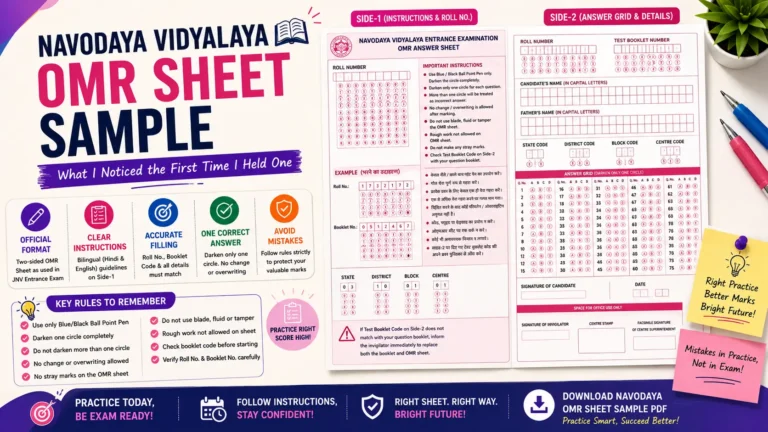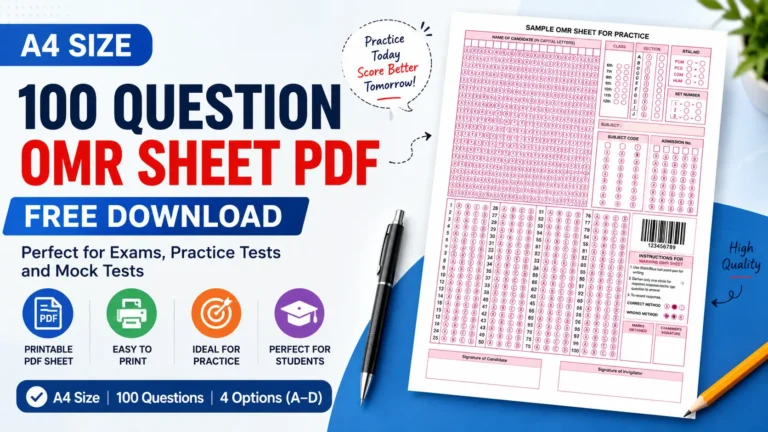
I still remember the exact moment my younger cousin’s face went completely pale. It was a Sunday morning, and we were running a full-length mock test for the All India Sainik Schools Entrance Examination (AISSEE) in our living room. He was a brilliant student, consistently topping his class. He knew his math formulas and science concepts inside out.
But with exactly forty minutes left on the clock, he froze.
He looked down at his answer sheet, then at his hand, and whispered, “I’ve been using a pencil.”
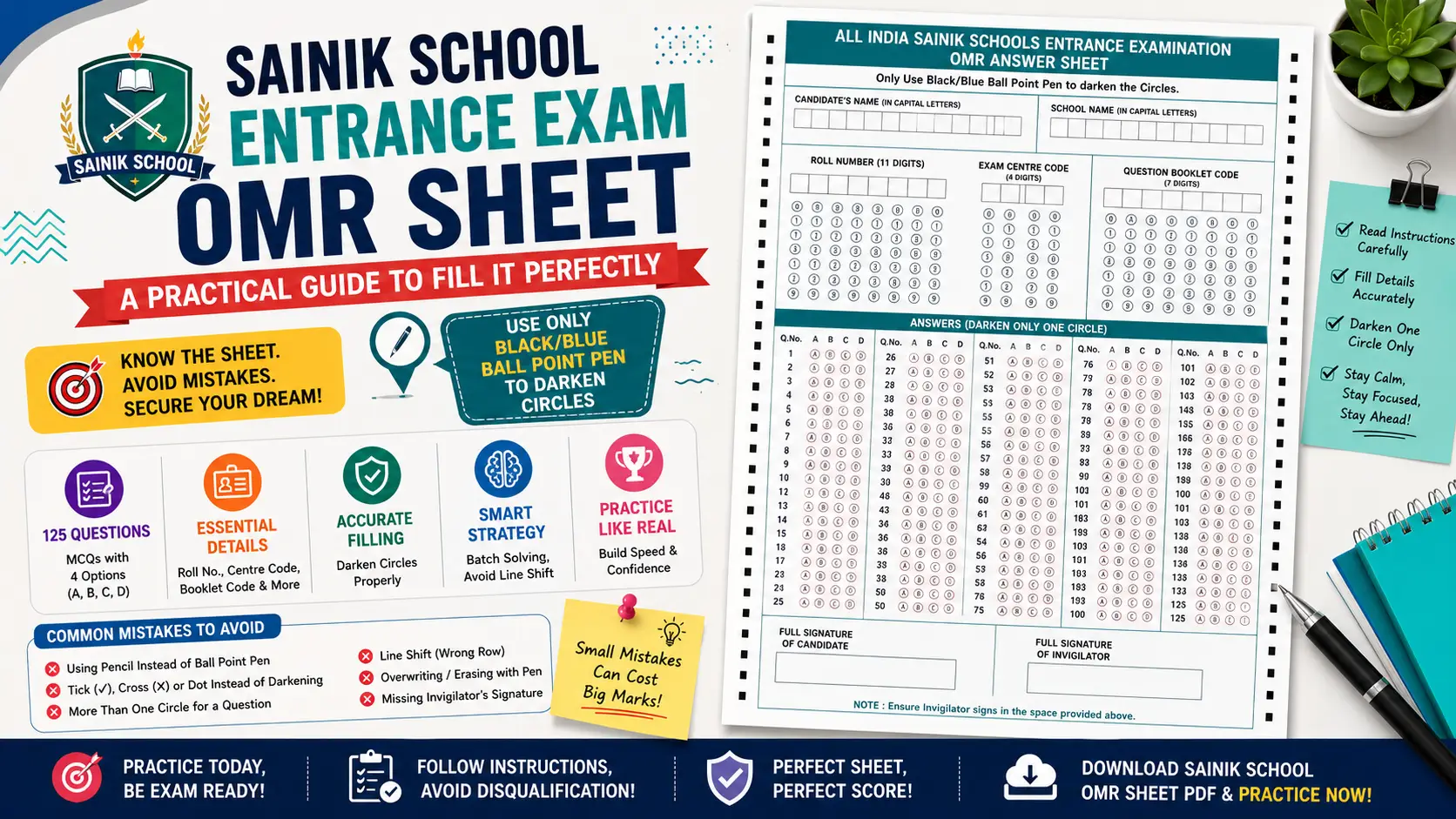
I looked at the practice Sainik School Entrance Exam OMR Sheet I had printed for him. Right at the top, in bold, clear instructions, it stated: ONLY USE BLACK/BLUE BALL POINT PEN TO DARKEN CIRCLES.
He had spent his entire academic life being told to use a soft HB pencil for OMR sheets. Out of pure muscle memory, he had bubbled fifty answers with a pencil. We had to stop the test right there. That single, stressful moment taught us both a massive lesson. Knowing the syllabus is only half the battle. Knowing how to handle the specific answer sheet is the other half.
If you or someone you know is preparing for the Sainik School entrance exam, you need to understand this sheet inside and out. Let me walk you through exactly how it works, the traps you need to avoid, and the step-by-step strategy I use to ensure no marks are lost to silly errors.
Decoding the Sainik School OMR Layout
The Sainik School OMR sheet is not your standard school test paper. It is highly structured and leaves zero room for ambiguity. When you first look at it, it can feel a bit overwhelming, but it is actually very logical once you break it down.
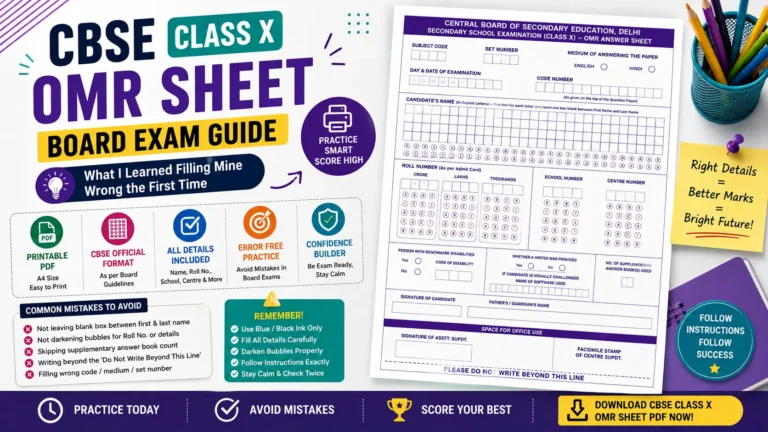
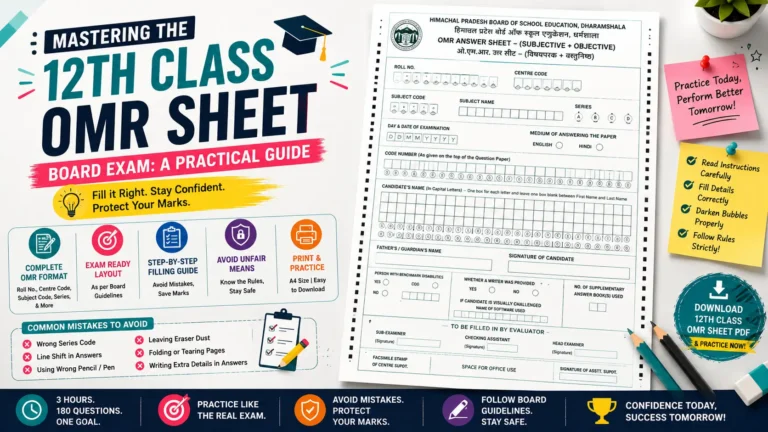
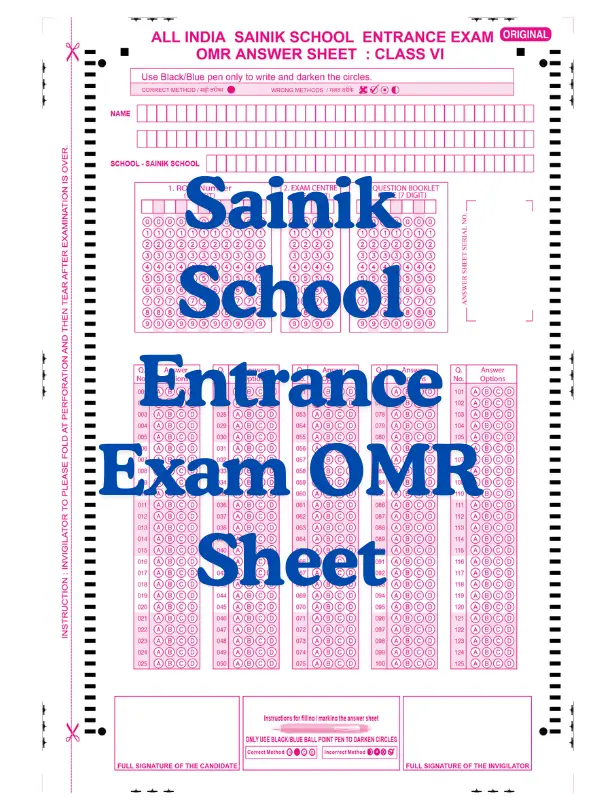
At the very top, you will see a section for your basic details. You must write your name and your school name clearly. Below that, there are three critical data blocks that the scanning machine relies on to identify you.
First is the Roll Number, which requires exactly 11 digits. You must write the number in the boxes and darken the corresponding circles below each digit.
Second is the Exam Centre Code, which is a 4-digit number.
Third, and most importantly, is the Question Booklet Code. This is a 7-digit code printed at the top of your actual question paper. If you copy this wrong, the computer will grade your answers against the wrong answer key, and your score will plummet.
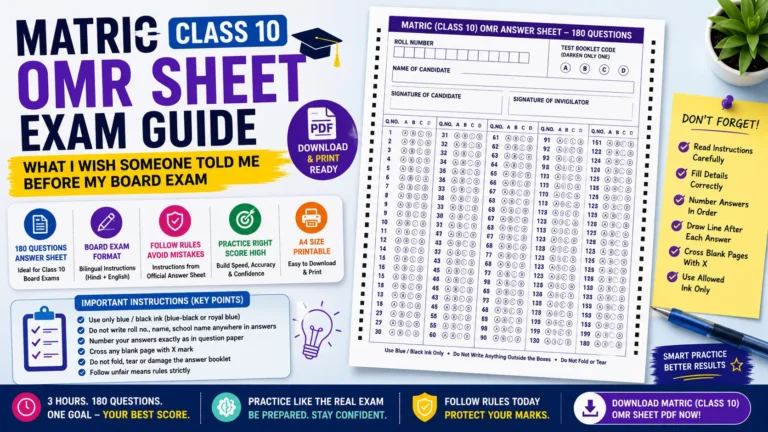
Below these details is the main grid. The sheet is designed for 125 multiple-choice questions. The questions are neatly divided into five columns, making it easier to track your progress. Each question has four options: A, B, C, and D.
The “Ballpoint Pen” Rule: Do Not Ignore This
I cannot stress this enough, because it is the number one mistake students make. Most educational boards and competitive exams train students to use a dark HB pencil for OMR sheets. Pencils are forgiving. You can erase them.
The Sainik School OMR sheet instructions explicitly state: ONLY USE BLACK/BLUE BALL POINT PEN TO DARKEN CIRCLES.
This is a strict requirement. The optical scanners used for this specific exam are calibrated to read the dense, consistent ink of a ballpoint pen. A pencil mark might be too faint, or it might smudge during handling, leading the machine to read it as a blank or a double answer.
I immediately threw away my cousin’s pencils and bought a pack of high-quality black ballpoint pens. We practiced with them exclusively from that day forward. I personally recommend pens like the Cello Butterflow or Reynolds 04. They provide a smooth, dark, and consistent ink flow without requiring you to press down so hard that the paper tears.
My Step-by-Step Filling Strategy
Over several mock tests, we developed a strict, foolproof routine for filling out this sheet. I highly recommend you adopt a similar routine to build strong muscle memory before the actual exam day.
Step 1: The Booklet Code Check
The very first thing you do when you receive the OMR sheet and the question paper is to check the Question Booklet Code. Find the 7-digit code on the top of your question paper. Write it in the designated box on the OMR sheet and darken the circles. Do this before you even read the first question.
Step 2: Roll Number and Centre Code
Next, carefully transfer your 11-digit Roll Number and 4-digit Exam Centre Code from your admit card. Double-check every single digit. A transposed number here can cause massive administrative headaches later.
Step 3: The Bubbling Rhythm
Do not solve all 125 questions and then try to bubble them all at the end. That is a recipe for a “line shift” disaster, where you accidentally skip a row and misalign the rest of your answers. Instead, bubble in batches. I recommend solving one full section (like Mathematics or Intelligence), and then immediately transferring those answers to the OMR sheet. This gives your brain a micro-break and keeps you perfectly aligned.
Step 4: The Signature Trap
At the bottom of the sheet, there are two signature lines. One is for the “Full Signature of the Candidate,” and the other is for the “Full Signature of the Invigilator.” You must sign your name clearly. Furthermore, you must ensure the invigilator signs their section before you leave the room. An unsigned sheet can be flagged or invalidated.
Real Tools to Practice at Home
You cannot master this skill just by reading about it. You need physical practice under timed conditions. Here are the exact tools I use to simulate the real exam environment at home.
First, I download a high-quality, printable Sainik School OMR Sheet PDF. I print it on standard, bright white A4 paper. I always go into my printer settings and select “Actual Size” or “100% Scale.” If the printer shrinks the page, the circles become too small, and your pen ink might bleed outside the lines.
Second, I use a focus app called “Forest” on my phone. I set it for the exact duration of the exam (usually two and a half hours). I then put the phone in another room. This prevents any temptation to check the time or get distracted, forcing total immersion in the paper.
Third, I use a free scanning app like CamScanner or Adobe Scan. After finishing a mock test, I scan my filled OMR sheet. Viewing it on a phone screen shows you exactly how a machine might see it. If a bubble looks faint, patchy, or has ink bleeding outside the circle, you know you need to adjust your bubbling technique.
Common Mistakes That Cost Valuable Marks
I have reviewed dozens of practice sheets, and I see the same errors repeated constantly. These are completely avoidable. Please read these carefully so you do not fall into these traps.
Mistake 1: The “Tick Mark” Habit
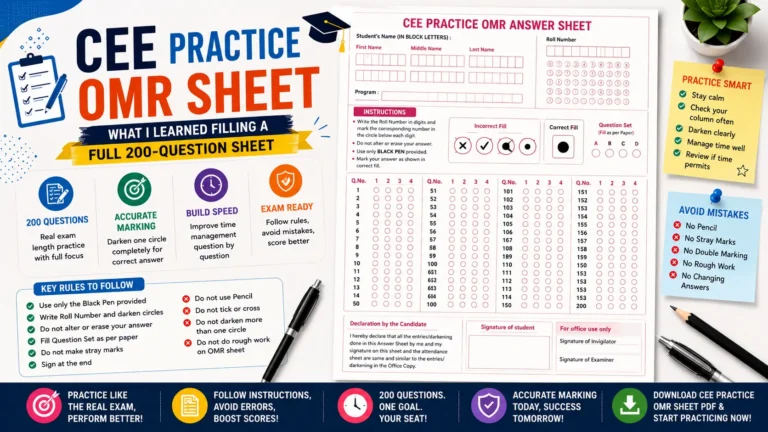
The official Sainik School OMR sheet actually includes a visual guide showing “Correct Method” versus “Wrong Methods.” The wrong methods include putting a small tick mark, a cross (X), or just a dot in the center of the circle. The scanner needs a fully, solidly darkened circle. Do not be lazy with your bubbling. Fill the entire space neatly.
Mistake 2: The Dreaded Line Shift
You skip question 42 in the booklet because it is too hard. But when you go to bubble, you accidentally fill the answer for question 42 into the slot for question 43. From that point on, every single answer is shifted and wrong. Always point your pen at the OMR row and your finger at the question number to verify they match before darkening.
Mistake 3: Erasing with a Pen
Because you are using a ballpoint pen, you cannot erase. If you make a mistake, do not try to scratch it out, use whitener, or draw a messy black box over it. The scanner will read that as a double answer and mark it wrong. The correct protocol is to leave the wrong bubble blank (or lightly cross it if instructed, though leaving it blank is safer) and ensure the new, correct bubble is perfectly darkened.
Mistake 4: Forgetting the Invigilator’s Signature
Students get so focused on their own details that they forget the invigilator must also sign. Before you hand over your sheet, politely point to the signature box and ask the invigilator to sign it. It takes two seconds and protects your hard work.
Final Thoughts on Exam Day
Mastering the Sainik School Entrance Exam is about more than just academic brilliance. It is about discipline, attention to detail, and managing your physical and mental energy.
Do not wait until the week before your actual exam to figure out how this specific OMR sheet works. Download a practice PDF today. Print it out. Sit down at a clean desk with a black ballpoint pen and a timer. Make your mistakes now, in the safety and comfort of your own home.
You have put in the hard work to learn the material. Do not let a silly, preventable bubbling error steal your success. Get your sheet, practice your strategy, and walk into that exam hall with absolute, unshakable confidence. You have got this.