I remember staring at this pink and white sheet for a good ten seconds before I even picked up my pen. It did not look like any answer sheet I had used before, with two full sides, tiny number grids, and instructions written in both Hindi and English. That confusion is exactly why I am writing this, because a lot of Navodaya aspirants feel the same way when they see this sheet for the first time.
If you are searching for a Navodaya Vidyalaya OMR sheet sample, you are probably preparing your child, your student, or yourself for the JNV entrance exam. I have gone through this exact sheet closely, section by section, and I want to break it down the way I wish someone had explained it to me.
Why This Sheet Looks So Different From a Normal OMR Sheet
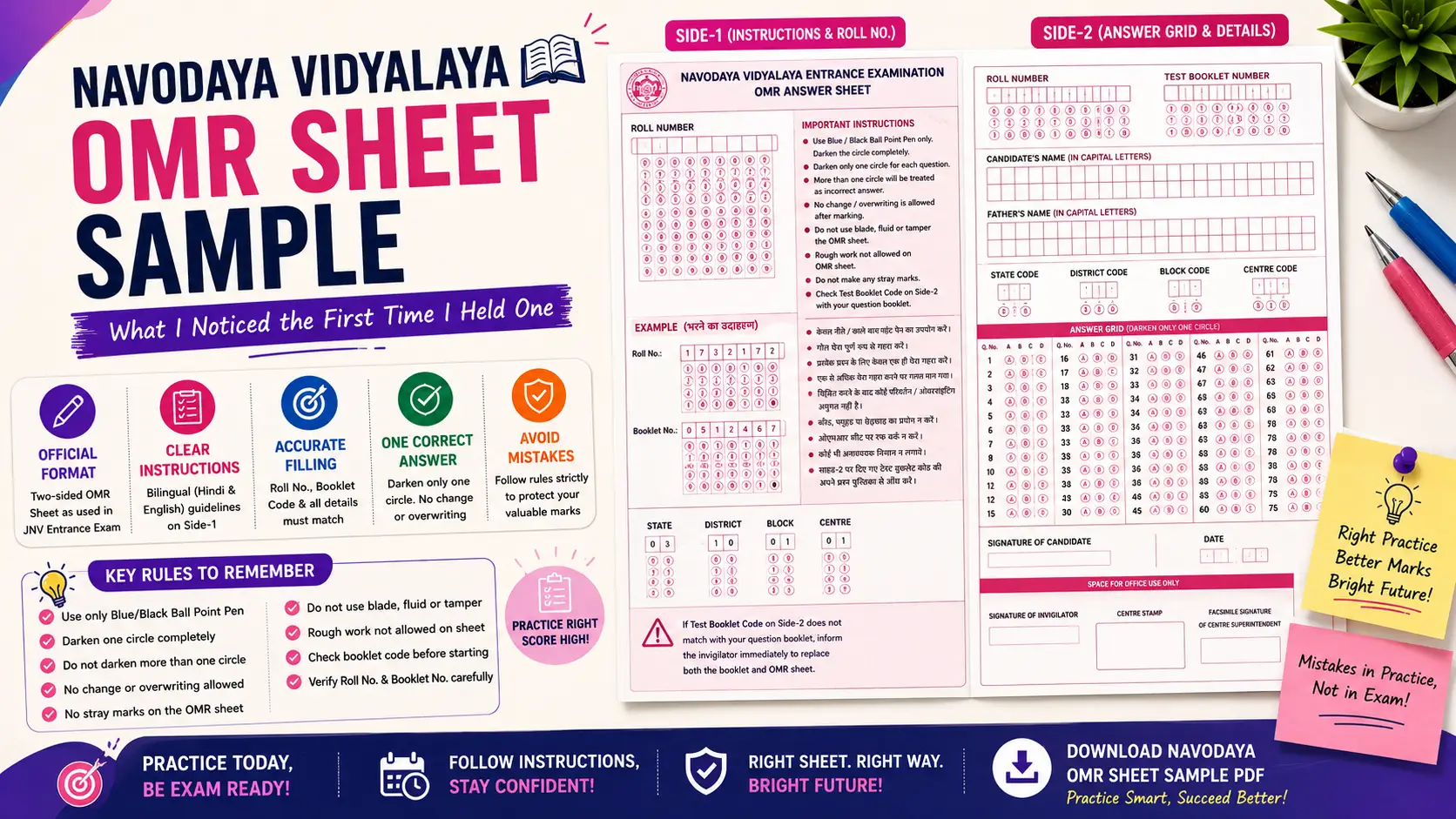
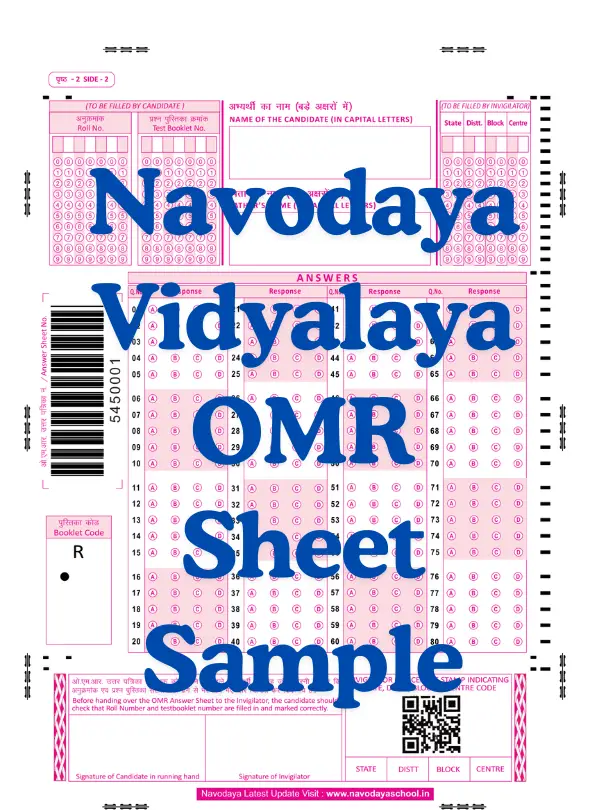
Most school-level OMR sheets are simple, just question numbers and bubbles in a single column. The Navodaya Vidyalaya OMR answer sheet is built completely differently, and it comes in two sides that work together as one unit. Side-1 mainly carries instructions and a smaller roll number grid, while Side-2 holds the actual answer grid along with candidate details.
The sheet clearly states at the top of Side-1 that all entries must be filled using only a blue or black ball point pen. This single instruction trips up a lot of students, since many are used to darkening bubbles with a pencil in regular school tests. I made this exact mistake during my first mock attempt, reaching for a pencil out of habit before catching myself.
What Side-1 Actually Asks You to Fill
Side-1 of the sheet starts with a Roll Number grid near the top left, where you fill in your digits and then darken the matching circles below each number. Right beside it, there is a full instruction block explaining exactly how to mark answers correctly on Side-2. This instruction block is not just filler text, it genuinely tells you the rules the OMR scanner follows when reading your sheet.
One important note printed clearly on Side-1 asks candidates to check that the Test Booklet Code printed on Side-2 matches the code printed on their actual question booklet. If these two codes do not match, the instructions say you must immediately inform the invigilator so both your booklet and OMR sheet can be replaced. I did not know this rule existed until I read it directly on the sheet, and it genuinely surprised me how specific this check is.
There is also a helpful example section on Side-1 that shows exactly how to fill in a sample Roll Number, Test Booklet Number, and even a sample State, District, Block, and Centre code. This example uses a sample Roll Number like 1732172 and a sample Booklet Number like 0512467, showing exactly which circles should be darkened for each digit. Seeing a filled-out example like this made everything click for me much faster than just reading plain instructions.
The Rules That Actually Decide Your Marks
A few rules on this sheet are not just formality, they directly decide whether your answer counts or not. The instructions clearly state there is only one correct answer for each question, and you must darken only one circle completely for that answer. Darkening more than one circle for the same question gets treated as an incorrect answer, no exceptions mentioned anywhere on the sheet.
Once you have marked an answer by darkening a circle, the sheet clearly states that no change or overwriting is allowed after that. This single rule changed how carefully I filled every practice sheet after I first read it. I stopped rushing through answers and started double-checking each question before darkening the final circle.
The instructions also specifically warn against making any stray marks anywhere on the OMR sheet, since incorrect or accidental marks can also get picked up by the scanner. Using any blade, fluid, or tampering method on the sheet is clearly listed as strictly prohibited. Rough work is also not allowed directly on the OMR answer sheet itself, which means you need a separate rough sheet ready before your exam.
Step-by-Step: How I Practice Filling This Sheet Now
After going through the sheet closely, I built a fixed order for filling it during practice, and I stick to this exact sequence every time now.
- I pick up only a blue or black ball point pen before starting, keeping a pencil completely out of reach.
- I fill my Roll Number in the box on Side-1 first, then darken the matching circles carefully below each digit.
- I move to Side-2 and fill my Roll Number again in the grid provided there, along with my Test Booklet Number.
- I write my Name and Father’s Name in capital letters exactly as shown in the boxes marked for candidates.
- I check the Booklet Code printed on Side-2 against the code printed on my actual test booklet before answering anything.
- I darken one complete circle for each answer, checking twice that I have picked the correct question number row.
- I avoid any stray marks, folding, or rough work directly on the sheet, keeping a separate paper ready for calculations.
- Right before handing the sheet in, I check that my Roll Number and Test Booklet Number are filled and marked correctly, exactly as the sheet itself instructs candidates to do.
This exact order stopped me from jumping between sections randomly, which is honestly where most careless mistakes happen with a two-sided sheet like this one.
A Mistake I Made During Practice
During one mock attempt, I filled my Roll Number digits clearly in the boxes but completely forgot to darken the circles below them. I only noticed this after finishing the entire answer section, and I had to go back and carefully darken each circle without smudging my earlier work. The sheet itself actually reminds candidates about this exact check right before the Invigilator signature section, and I genuinely understand why now.
Another time, I accidentally darkened two circles for the same question because I changed my answer at the last moment without realizing overwriting was not allowed. According to the sheet’s own instructions, this counts as an incorrect answer no matter how confident I was about the correct option. That mistake taught me to think through my answer fully before darkening anything, rather than treating it as something I could fix later.
Real Example: State, District, Block, and Centre Codes
One section that confused me at first was the State, District, Block, and Centre code grid on Side-2, meant to be filled by the invigilator rather than the candidate. Side-1 actually shows a clear example of this, using sample codes like State 03, District 10, Block 01, and Centre 01. Seeing this example helped me understand that candidates should not worry about filling this particular section themselves during a real exam.
The sheet also has a section for a Centre Stamp near the bottom of Side-2, where the invigilator marks the State, District, Block, and Centre details officially. Understanding which sections belong to the candidate and which belong to the invigilator saved me a lot of unnecessary confusion during my practice sessions.
Common Mistakes to Avoid
Based on my own practice attempts and details taken directly from the actual sheet instructions, these mistakes come up most often.
- Using a pencil instead of a blue or black ball point pen, which goes against the sheet’s clear instructions.
- Writing digits or letters in the boxes but forgetting to darken the matching circles below them.
- Darkening more than one circle for the same question, which the sheet treats as an incorrect answer.
- Changing an answer after it has already been marked, since overwriting is not allowed once darkened.
- Doing rough work directly on the OMR sheet instead of using a separate paper.
- Not checking the Test Booklet Code on Side-2 against the actual question booklet before starting.
Catching even a few of these early during practice genuinely reduces the chances of losing marks over small, avoidable errors.
Final Thoughts
The Navodaya Vidyalaya OMR sheet is more detailed than most students expect, with two full sides working together and rules that directly affect how your answers get scored. I only understood this properly after going through the sheet closely and noticing details I had completely missed on my first glance. Reading through the actual instructions once, calmly, before a real practice attempt makes a genuine difference.
Get a proper sample of this sheet, follow the exact filling order from Roll Number to final answer marking, and treat every practice round like your real exam. By the time your actual Navodaya entrance exam arrives, filling this two-sided sheet correctly will feel completely natural, leaving your full focus on solving the actual questions.