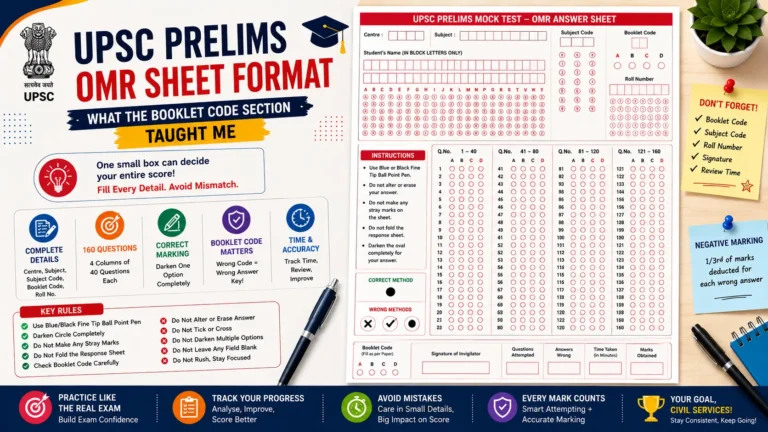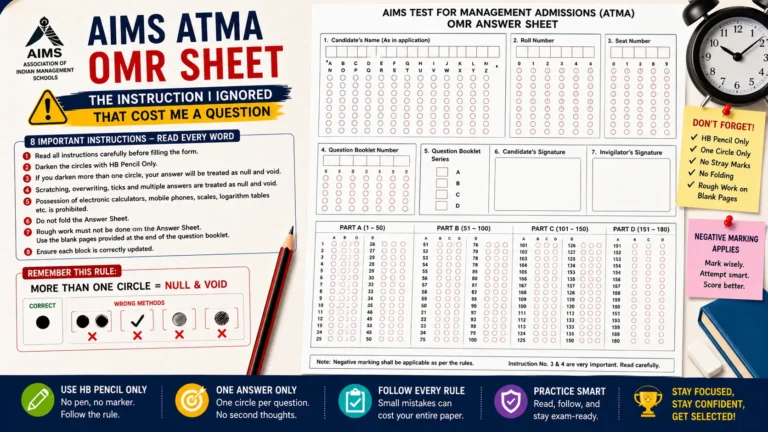
I changed my mind about an answer halfway through a Indian Railways OMR Sheet mock test, scratched out my first mark, and darkened a new circle right next to it. When I checked the instructions properly later that evening, I found a line stating that once an option is marked, it cannot be changed at all. My “corrected” answer would have been read as scribbled and wrong, exactly like the instructions warned.
If you are preparing for an Indian Railways recruitment exam and practicing with the actual Railways OMR answer sheet format, this 110-question sheet is exactly the kind of format regional divisions like Pune use for their exams. I have gone through this exact sheet closely during my own practice, and I want to share the details that genuinely surprised me.
What Makes This Indian Railways OMR Sheet Different From Other Formats
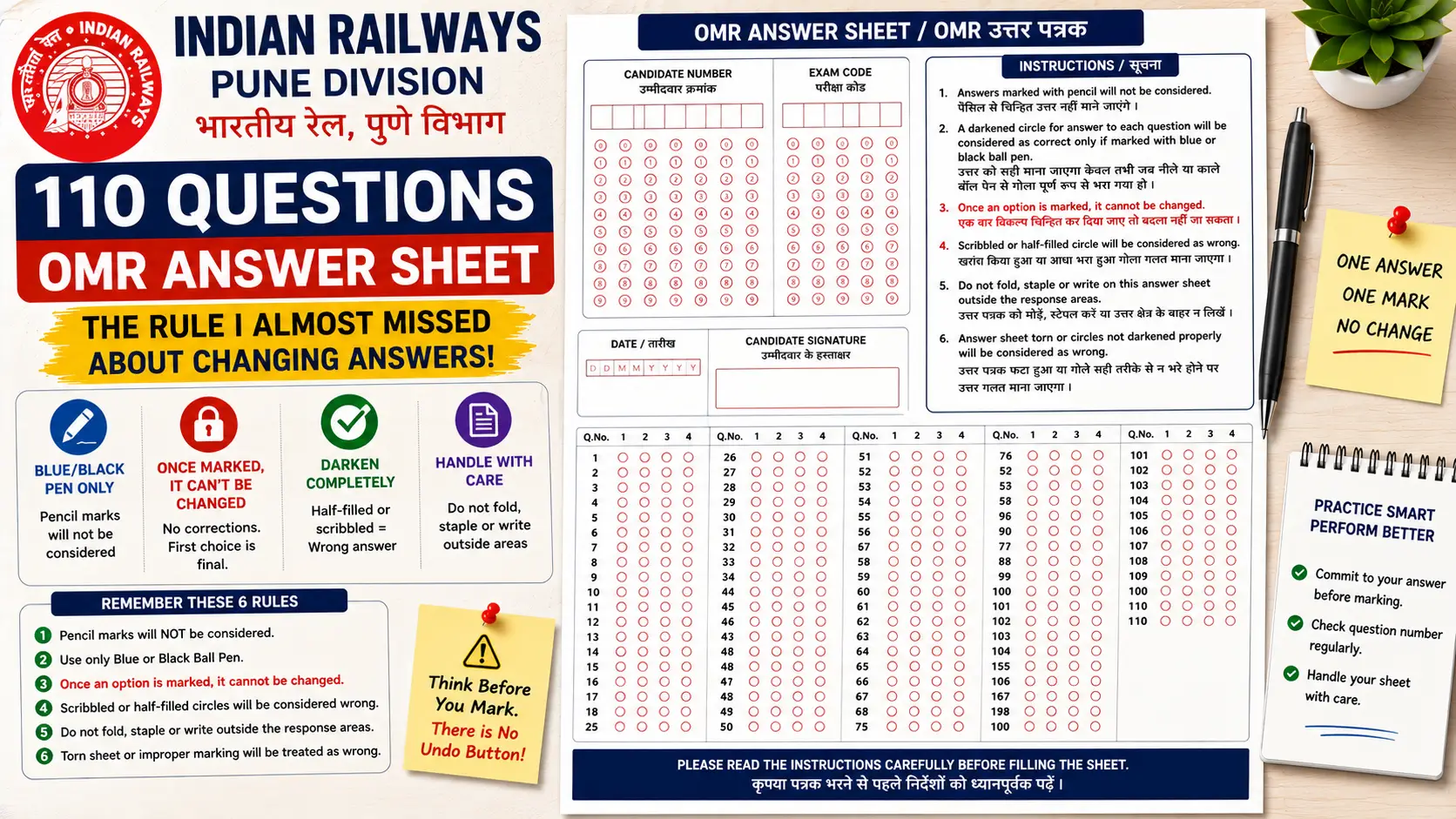
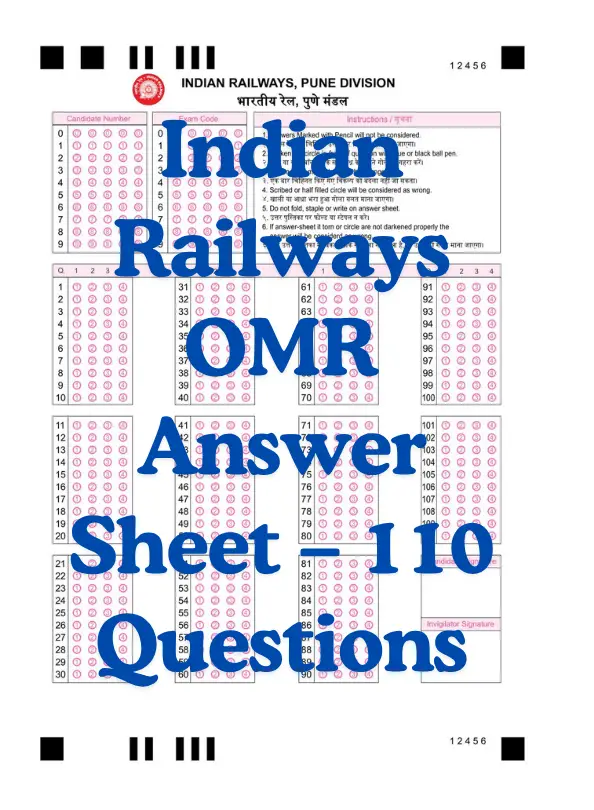
This specific sheet is issued under Indian Railways, Pune Division, and it carries the official Railways emblem right at the top next to the division name printed in both English and Hindi. Unlike simpler practice sheets I had used before, this one starts with a Candidate Number grid on the left and a separate Exam Code grid right beside it, each using standard 0 through 9 digit circles.
What caught my attention immediately is that the answer options throughout this sheet are numbered 1, 2, 3, and 4, rather than the lettered A, B, C, D format I was used to from other exams. This numbered option style is common across several Railways recruitment exams, and getting comfortable with it during practice genuinely helps avoid confusion on the actual exam day. I remember pausing during my first mock attempt, double-checking my question paper to confirm the option numbering actually matched what I saw on the sheet.
The Six Instructions That Actually Decide Your Score
Printed clearly in a bilingual Instructions or सूचना box, this sheet lists six specific rules that genuinely shape how your answers get evaluated. The very first instruction states plainly that answers marked with pencil will not be considered at all. This immediately tells you that, unlike some other exam formats that require pencils specifically, this Railways sheet expects something different entirely.
The second instruction clarifies that a darkened circle for each question will be considered as correct only if marked with a blue or black ball pen. Reading these first two rules together made it clear that pencil marks are treated as if they simply do not exist on this particular sheet, not just discouraged but genuinely ignored during evaluation.
The Instruction I Learned the Hard Way
The third instruction is the one that caught me off guard during my own practice. It states clearly that once an option is marked, it cannot be changed. This is stricter than several other formats I had used before, which at least allowed a properly erased and re-marked answer under certain conditions. On this sheet, your first decision is final, whether you meant it to be or not.
The fourth instruction reinforces this same idea from a different angle, stating that a scribbled or half-filled circle will be considered as wrong. My earlier attempt at scratching out one mark and darkening a new circle right next to it falls exactly into this category. That single mock question would have counted against me exactly as if I had answered it incorrectly, purely because of how I marked it, not because of what I actually knew.
Handling and Physical Care of the Sheet
The fifth instruction is short but important, stating that you should not fold, staple, or write on the answer sheet outside of the designated response areas. The sixth and final instruction ties everything together, stating that if the answer sheet is torn or if circles are not darkened properly, the answer will be considered wrong. Together, these six rules paint a clear picture of a sheet that leaves very little room for carelessness, whether that carelessness involves your pen choice, your handling of the paper, or your decision-making process while marking answers.
Step-by-Step: How I Practice With This Exact Sheet Now
After my scratched-answer mistake, I built a strict order for filling this sheet, and I follow the exact same sequence for every single practice round now.
- I pick up only a blue or black ball pen before starting, keeping any pencil completely out of reach during practice.
- I fill my Candidate Number and Exam Code grids first, carefully darkening the matching circle below each individual digit.
- I read through all six printed instructions once more, refreshing my memory before touching a single answer.
- I solve each question fully on a separate rough sheet first, committing to my final answer before marking anything on the OMR sheet.
- I darken exactly one complete circle per question, treating every mark as permanent, since changes are not allowed on this sheet.
- Since the sheet spans 110 questions organized in multiple columns, I check my question number every ten to fifteen questions to stay aligned.
- I keep the sheet completely flat throughout my practice session, never folding, stapling, or writing on it outside the answer areas.
- Once finished, I sign in the Candidate Signature box, leaving the Invigilator Signature section blank during practice, exactly as it would be during a real exam.
This exact order stopped me from rushing into answers impulsively, which is honestly where my earlier scratched-mark mistake actually came from in the first place.
Real Example: Why Commitment Matters More Here Than Elsewhere
A colleague of mine preparing for a Railways technical post exam mentioned that she always double-checks her answer choice against the question paper one final time before darkening any circle. She treats this final check as her only real safety net, since the sheet itself gives no room for correction afterward. She told me this habit, built specifically around this sheet’s no-change rule, genuinely reduced her second-guessing mistakes across several months of mock practice.
I adopted this same double-check habit after seeing how well it worked for her. Knowing there is truly no going back on this particular sheet forced me to slow down just enough before marking each answer, without actually costing me significant time across the full paper.
Common Mistakes to Avoid
Based on my own practice attempts and the details printed directly in the sheet’s own instructions, these mistakes come up most often with this Railways format.
- Using a pencil instead of the specifically required blue or black ball pen mentioned in the first two instructions.
- Attempting to scratch out or change an answer after it has already been marked, which is explicitly not allowed.
- Darkening a circle only partially, since a half-filled circle is treated exactly the same as a wrong answer.
- Folding, stapling, or writing on the sheet outside the designated response areas.
- Losing track of your question number across the sheet’s multiple columns, especially past the hundred-question mark.
Catching even a couple of these mistakes early during your own mock practice genuinely reduces the risk of losing marks over avoidable errors, not actual knowledge gaps.
Final Thoughts
The Indian Railways OMR Answer Sheet for 110 questions leaves no room for changing your mind once a circle is marked, and understanding this rule properly makes a real difference to how you approach your practice. I only understood how strictly this sheet treats a scratched or altered mark after nearly losing a mock question to my own indecision. Once you commit fully to each answer before marking it, this sheet becomes far less intimidating and far more predictable to work with.
Practice with a proper Railways-style OMR sheet regularly, using only a blue or black pen and double-checking every answer before you darken it. By the time your actual Railways recruitment exam day arrives, filling this sheet correctly and confidently will feel completely automatic, leaving your full focus on the 110 questions that truly decide your result.